
The SCINOP Journey: Evidence-Informed Policies for Healthy Mothers and Children
The SCINOP project (Driving Scientific Citizenry and Knowledge-to-Policy Adaptation in Maternal Child Health) is reshaping how Kenya uses evidence to strengthen maternal and child health (MCH) policies.
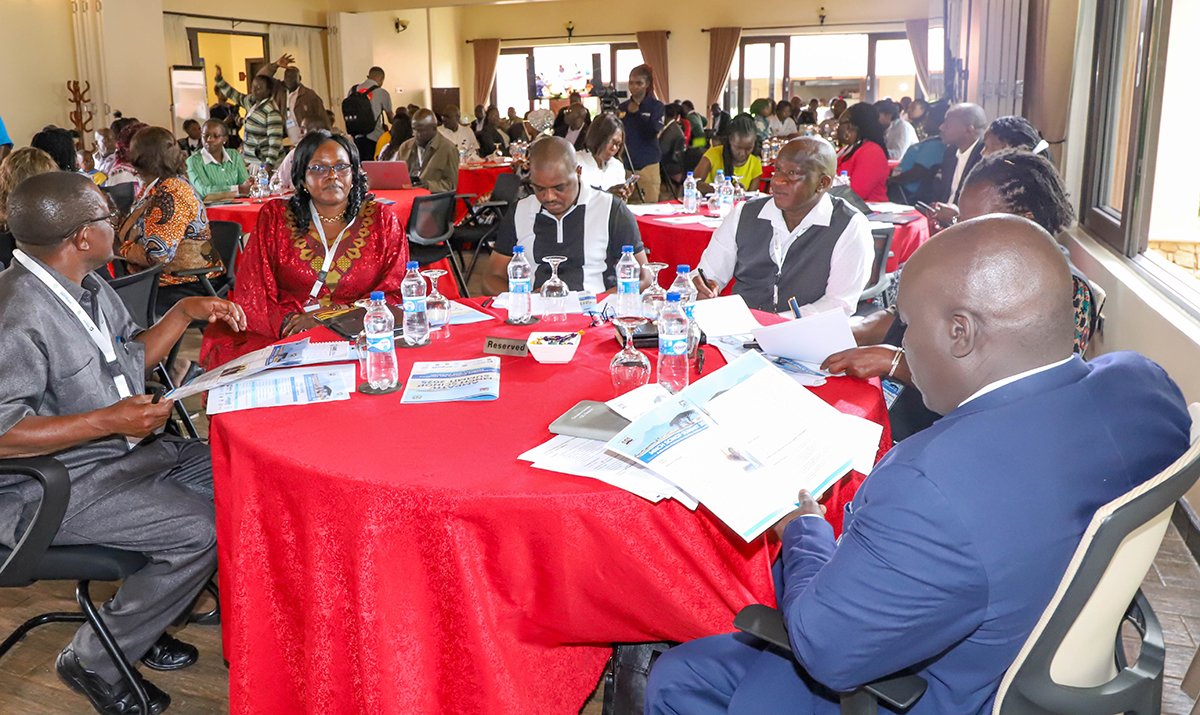
The Maternal Child Health Summit, with key stakeholders including Bungoma County Deputy Governor, Moi University College of Health Sciences, Ministry of Health and other partners. Photo credit: SCINOP Communications Project Team.
Despite global progress, Kenya continues to face high rates of maternal and child morbidity and mortality. SCINOP was launched in October 2024 to help address these challenges by improving how policy and research institutions generate, interpret, and apply evidence in decision-making. It is one of four East African initiatives funded under the World Health Organization’s Alliance for Health Policy and Systems Research Knowledge Systems for Africa program.
A central focus of SCINOP is supporting county-level decision-making. The project builds on AMPATH’s work in strengthening national knowledge systems by formalizing partnerships among Moi University, the Ministry of Health and County Departments of Health. It introduces new approaches to evidence synthesis and rapid reviews tailored to Kenya’s MCH policy priorities while helping institutions strengthen their capacity for advocacy and policy analysis.
Since its inception, the project has created stronger links among researchers, county health departments, and policymakers, ensuring that evidence guides decisions at every level. “Health care is a key priority for my government, and maternal and child health lies at the very heart of it,” said Bungoma Governor Kenneth Lusaka. “Therefore, we truly value AMPATH’s consistent partnership and the support it has offered to complement health services across the county.”
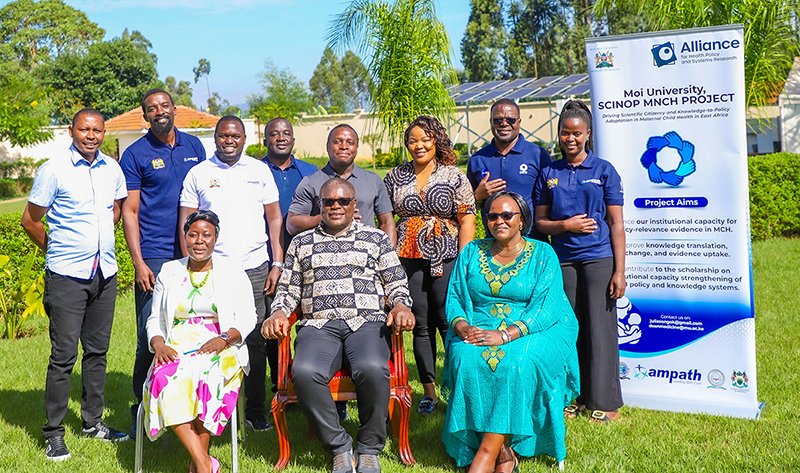
SCINOP debrief meeting with Governor Kenneth Lusaka of Bungoma County. Photo credit: SCINOP Communications Project Team.
County leaders describe the collaboration as a foundation for long-term transformation. Dr. Emma Nyaboke, deputy director of Health Services in Bungoma County, said the project has shown the importance of working together to interpret and apply research. SCINOP builds on the strong foundation between Bungoma County and AMPATH and marks a new chapter in improving care for mothers and children across the region.
These efforts have helped shift institutional culture in Bungoma and Busia Counties, where SCINOP task forces made up of technical health managers now guide evidence use in developing actionable policies.
One milestone was the Maternal Child Health Summit held in Bungoma in July 2025. The forum brought together national and county officials, technical teams, and partners to review evidence, align priorities, and discuss policy gaps. Participants described it as a turning point that deepened shared understanding across political and technical sectors. The summit reinforced the idea that responsive policy requires continuous learning, collaboration, and data-driven decision-making.
SCINOP’s work extends to regional and global platforms. The project participates in annual learning forums hosted by the Alliance for Health Policy and Systems Research, sharing insights with other African countries working to strengthen evidence-informed policies. Team members have also presented at global conferences and engaged in communities of practice focused on knowledge transfer across low- and middle-income countries.
To sustain progress, the SCINOP team co-created a short Science for Policy course tailored for Department of Health technical managers and decision-makers. Developed by a team from Moi University’s School of Public Health, School of Medicine, School of Information Sciences and Director, Quality Assurance, Compliance and Performance Contracting, the course draws on a needs assessment and multiple stakeholder reviews. Hosted by the university’s College of Health Sciences, it teaches practical skills in finding and summarizing evidence, preparing policy briefs, and strengthening research and evidence units at the county level. The course will be piloted with county health teams and is intended to support routine use of local data in policy and budgeting decisions.
SCINOP leaders describe the project as a collaborative effort that brings together counties, ministries, researchers and communities. By building systems that value evidence, the initiative aims to establish a sustainable model of policymaking that improves outcomes for mothers and children in Kenya and sets a standard for MCH policy across the region.
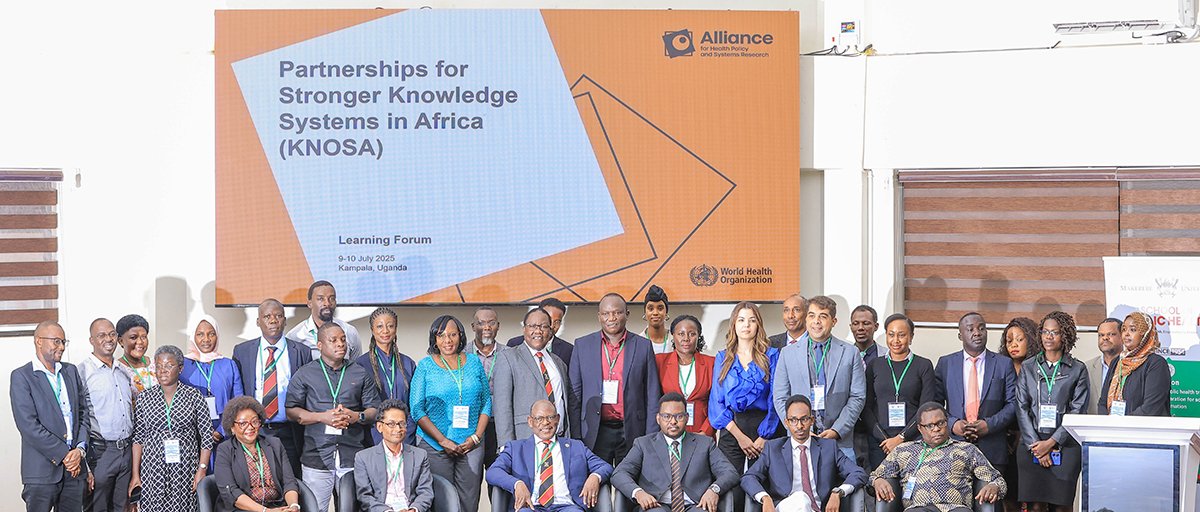
Highlights from the KNOSA Learning Forum in Kampala, featuring participants from across Africa, the SCINOP project team, Bungoma County Governor Kenneth Lusaka, and Busia County Deputy Governor Hon. Arthur Odera. Photo Credit: Makerere University Team