
Medical Students Reflect on AMPATH Partnership Clinical Rotations
This year, more than two dozen medical students from Moi University School of Medicine in Kenya and the University for Development Studies in Ghana participated in international clinical rotations at 12 of the AMPATH Consortium's partners in the U.S., Canada and Sweden. While at their host institutions, the students experienced new medical situations and enjoyed new cultural experiences. Trainee exchanges are the foundation on which the AMPATH partnership was built. Trainee exchanges have been integral to the partnership since its founding. We’ll share their reflections in a series of website and newsletter stories. This month, hear from students who visited Texas, Indiana and Kaiser Permanente:
University of Texas at Austin
Kevin Kiptoo Rop: The most important lesson for me has been that a strong hospital system is not defined only by technology or infrastructure. Dell Children’s has shown me the value of standardized processes, robust interdisciplinary communication, detailed documentation and deliberate family engagement. MTRH has taught me the equally important skills of clinical resilience, prioritization, resource stewardship and maintaining compassionate care when demand is high. Observing both settings has reinforced that patient safety depends on systems, but excellent care also depends on clinicians who can think critically, communicate clearly and advocate for each patient regardless of the setting.
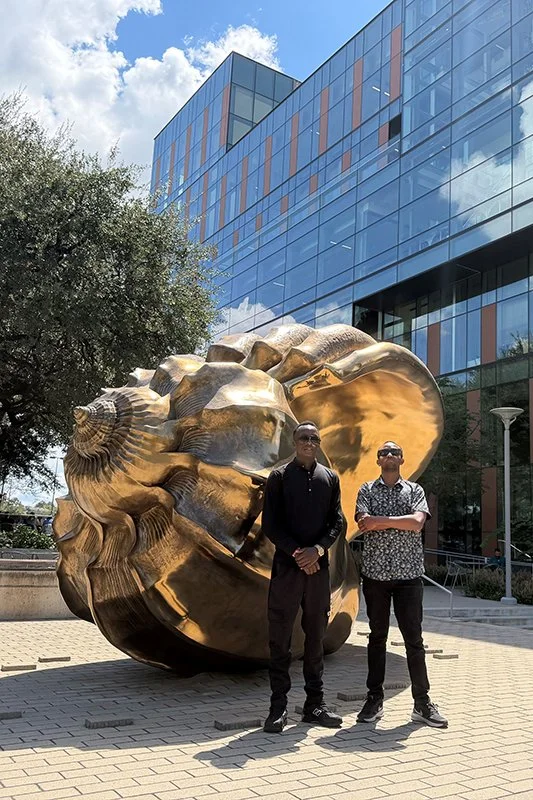
Kevin and Allan in the courtyard at Dell Medical School
Allan Kimani Ndirangu: I see myself being a skilled physician and thoroughly proficient in my practice. I visualize the future inclining towards a more technological approach to medicine with limited physician encounters with patients. This will not hinder me from actively being involved in direct patient care, yet I will keep up also with the times. I also envision being a mentor to medical students starting out in their career just as my seniors mentored me. This opportunity is a great experience to show me how medicine is practiced when the resources are not as limited as in my home country. The knowledge and skills I hope to gain will not only make me a competent doctor but also guide my colleagues in improving how they practice medicine. This experience will enable me to help and guide other medical students to get similar opportunities in the future. It will also be beneficial in developing cross-cultural awareness and empathy if I wish to practice medicine outside my home country. Additionally, this opportunity will aid me in building a bridge between medical providers from other countries and the ones in Kenya.
Indiana University
Siliman Brian
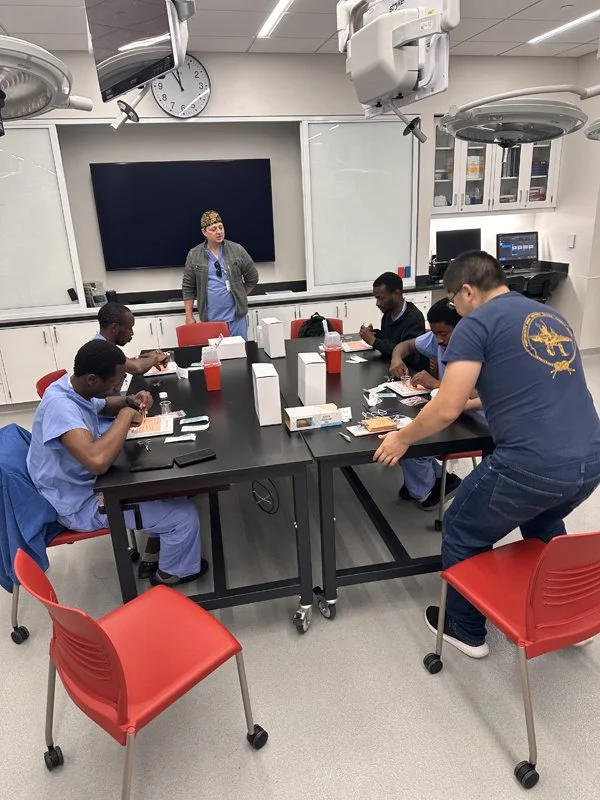
Moi medical students in the IU School of Medicine surgery skills lab
It was my first time traveling out of my country and my first ever time flying on a plane. The moment started even before getting to the United States. First flying in a Jambojet, next a Boeing, an Airbus. That was a significant part of my life and I'll long for more of that. My career path is seemingly leading me to surgery and I love that about myself. The pride of getting to make a life changing decision, after seeing the ultimatum of the future prospects of surgery and medicine. In Adler's psychology, he described it as we are who we become. Lastly, I thank the AMPATH program and our universities for this exchange program. We're a step closer to attaining sustainable development goals with this global health training.
Brian Wambui
It is difficult to choose a single memorable experience because every part of the observership has been unique and meaningful in its own way. However, since travelling is something I genuinely enjoy, the trips north to Chicago and south to Bloomington would have to be at the top of my list. While visiting new places was certainly exciting, what made these trips particularly meaningful were the relationships we formed with our hosts along the way. Getting to experience these places through the people who welcomed us, sharing conversations, meals, stories, and everyday moments, made the trips feel like much more than simply visiting new cities. They gave us an opportunity to connect with people beyond the hospital environment and created memories that I will carry with me long after this experience. In many ways, I have learned that the most memorable part of travelling is not necessarily the place itself, but the people with whom you share the experience.
Victor Orende
To be candid, every part of my brief stay at the United States was definitely memorable, but the most memorable of all was getting to experience how far advanced medicine has gotten in terms of technology; with specific mention for robotic surgery. It was an auspicious experience interacting with robotics at the new Indiana University School of Medicine’s Simulation Lab and at some point observing robotic surgeries through the Da Vinci's high definition stereo viewer in the ORs. With the much I have learned and experienced, I envision an impactful career in which — as a compassionate medical leader in Kenya and beyond — I will champion for equitable access to healthcare, dignified patient-centered care and sustainable medical innovation, possibly for the next generation.
Kaiser Permanente
Sherlyn Chemutai Kirui
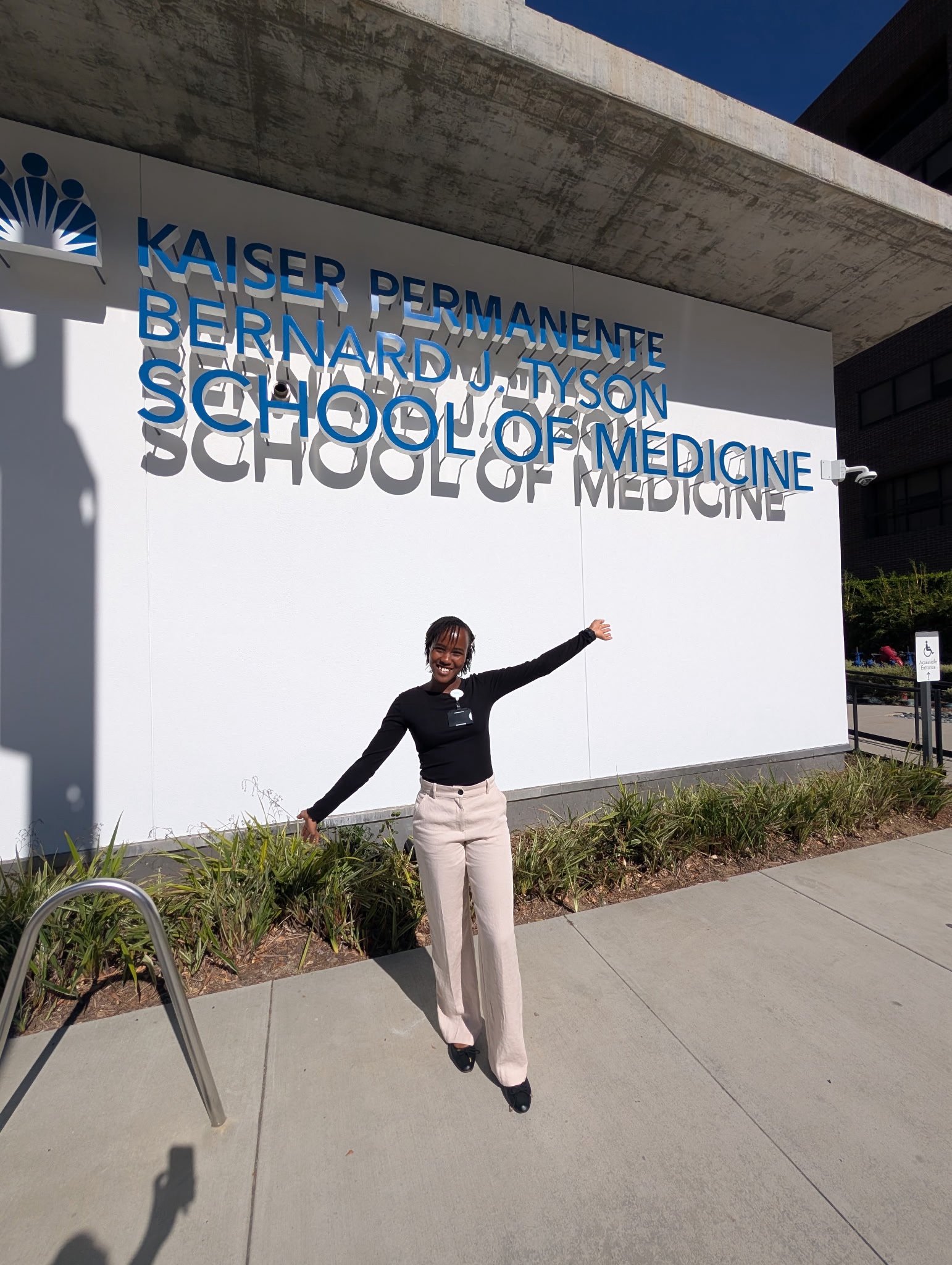
Sherlyn in front of the medical school
The most memorable thing I’ve learned is how to do point of care ultrasound which is a skill that I’ll carry with me back to Moi University and beyond. This has been a turning point, and I see myself and my career as not only impacting patients’ lives but also challenging the system. Creating a system where patient follow-up is easy and assured and patients are well-informed. The exposure to an integrated health system at Kaiser Permanente is an example that it is possible.