
Defying the Odds and Rewriting the Story of Sickle Cell Disease
When Clarice Ooro was diagnosed with sickle cell disease at just two months old, her family could not have known the journey that lay ahead. Thirty-five years later, her story has become one of courage, care and hope, while challenging the fear and misconceptions that have long surrounded the condition.

Clarice Ooro
For Clarice’s family, the fear associated with sickle cell disease was deeply personal. As the fifth born in a family of eight children, her journey is tied to the painful memory of an older sibling who died before the family fully understood the disease and how it could be managed. That loss remained with them, but it also became a turning point. It strengthened their resolve to seek information, pursue care and support Clarice through every stage of her life.
Today, Clarice’s life speaks to what is possible when families, health workers and communities walk alongside people living with sickle cell disease. At 35, she has lived beyond one of the most common misconceptions, that children born with the condition cannot survive into adulthood. She has also challenged another deeply held belief, that people living with sickle cell disease cannot become parents or lead full lives. Clarice is a proud mother of two.
Sickle cell disease is an inherited blood disorder that affects the red blood cells. Instead of remaining round and flexible, the red blood cells become hard, sticky, and crescent shaped. These abnormal cells can block blood flow, reduce oxygen supply to the body, and cause episodes of severe pain, chronic anemia, fatigue, infections, and, in some cases, damage to vital organs. The Ministry of Health estimates that about 14,000 babies are born with the condition every year, with the burden highest in malaria endemic regions such as the Coast, Western Kenya and the Nyanza Region.
Growing up with sickle cell disease meant that hospital visits, blood transfusions and seasons of pain became part of Clarice’s life from an early age. Her parents, relatives and the medical team at Moi Teaching and Referral Hospital (MTRH) and AMPATH walked with her, helping her understand the condition, manage complications, and keep hope alive.
“Sickle cell has not been an easy journey,” Clarice says. “There have been painful days, many hospital visits, and times when I felt weak and afraid. But I have also received so much support from my family and my doctors. They have carried me through the difficult moments, and their care has helped me keep going.”
Clarice’s story reflects the broader work of AMPATH and partners at Innovative Hematology, Inc., who have been strengthening sickle cell care in Kenya for more than 14 years. Through this work, AMPATH partners have walked alongside more than 5,000 patients and families, providing the care and support needed to understand sickle cell disease, manage complications and live more positively with the condition.
Through the programme, AMPATH has strengthened the capacity of health workers across the country to diagnose, treat and support people living with sickle cell disease and other blood disorders. It has also supported early diagnosis through testing and screening, helping children with sickle cell disease to be identified early and linked to care. For patients and families, this means improved access to regular follow up, affordable medication and comprehensive care.
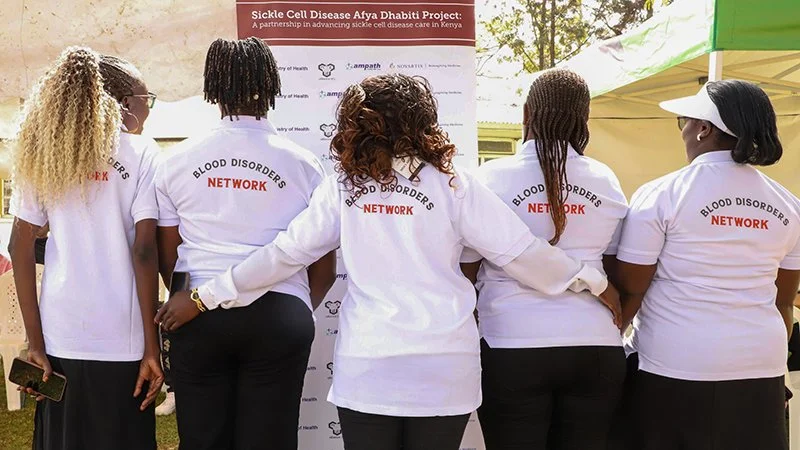
World Sickle Cell Day is June 19
“Access to care has made a big difference in my life,” Clarice says. “Hydroxyurea has helped me manage the condition better, and I am grateful that I can access my medication and follow up care affordably through MTRH and AMPATH. I have also learned to be consistent with my care by taking my medication, drinking enough water, eating well, attending clinic and seeking help early when I feel unwell.”
As part of activities to mark World Sickle Cell Day on June 19, the AMPATH sickle cell partnership held a blood drive to support patients who depend on blood transfusions as part of their care. For people living with sickle cell disease, access to safe blood can be lifesaving, especially during severe anemia, painful crises or other complications.
Speaking during the event, Clarice reflected on what blood donation has meant in her own journey.
“Seeing people donate blood holds a special place in my heart,” she said. “I have received transfusions since I was a baby, and I know how precious every drop can be. When you donate blood, you save a life.”
Clarice’s story is a powerful reminder that sickle cell disease is not only a story of pain, but also one of resilience, care and possibility. As AMPATH’s sickle cell program continues to advocate for early testing, timely linkage to care, access to lifesaving treatment and regular blood donation, more people living with sickle cell disease can be supported to live healthier and more hopeful lives.