
Expanding Care for Hypertension and Diabetes Across Western Kenya
In resource-limited towns and villages across western Kenya, community health promoters teach their neighbors about blood pressure and blood sugar in practical terms, explaining what the numbers mean and why they matter. One by one, community members extend their arms for screening. Some are reassured. Others are surprised.
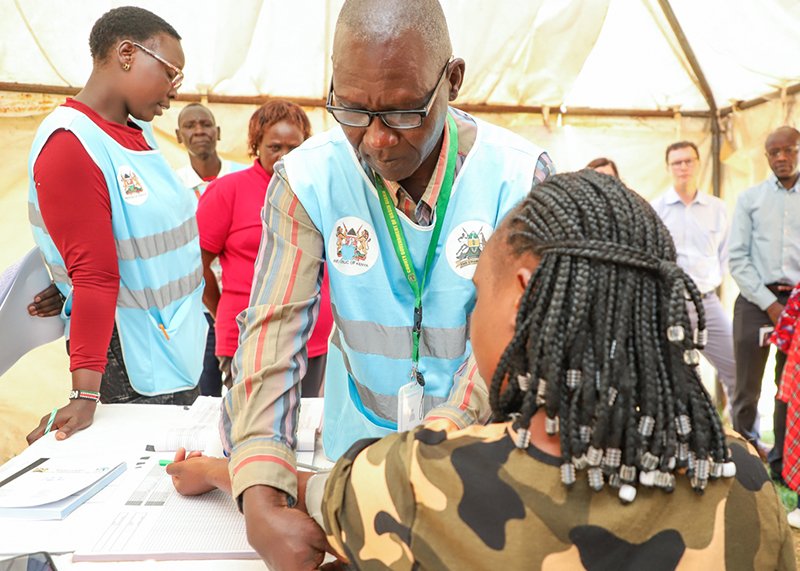
For many, it is the first time they have ever been tested.
High blood pressure (hypertension) and high blood sugar (diabetes) are serious but treatable health challenges, however many people in western Kenya remain undiagnosed until they develop serious complications. Since July 2024, AMPATH’s Chronic Disease Management program in western Kenya has expanded to change that reality.
Today, 23 facilities in Uasin Gishu, Elgeyo Marakwet and Trans Nzoia counties offer integrated blood pressure and blood sugar screening, diagnosis, linkage to care, and follow-up services as standard practice. This work is supported by a three-year grant from the Eli Lilly and Company Foundation to Indiana University, which Indiana University dedicated to support AMPATH’s work in resource-limited settings in in Ghana, Kenya and Nepal.
In Kenya, noncommunicable diseases (NCDs) such as hypertension and diabetes cause more than 50 percent of hospital admissions and 39 percent of deaths annually, with resulting cardiovascular disease driving the majority.
“We are building a system where patients can be screened in their communities and continue care at their local health facility,” said Dr. Jemima Kamano, AMPATH Global NCD Initiative lead and senior lecturer at Moi University School of Medicine. “That continuity is essential for lifelong conditions like hypertension and diabetes.”
Early detection and education are essential to preventing complications from hypertension and diabetes. Community health promoters are central to this effort. AMPATH has trained 368 community health promoters to conduct screening, provide health education, and link patients to care in local facilities.
These community health promoters have contributed to reaching more than 316,143 people with education and screening activities across the three counties, bringing lifesaving information and services closer to families.
“We are seeing people diagnosed earlier, before they develop stroke, kidney failure, or heart disease,” said Dr. Charity Wambui, the program’s leader for AMPATH Kenya. “When care is available in local facilities and reinforced by community health promoters, people are more likely to seek and stay in care.”
In addition to door-to-door visits and baraza (community meeting) discussions, radio programs have reached more than 150,000 listeners with messages about chronic disease prevention and care. Peer-led support groups have also formed in several communities, helping people adhere to care and lifestyle changes beyond their clinic visits.
Program Highlights (July 2024-December 2025)
23 facilities supported
81,621 people screened for diabetes with 537 linked to care
65,419 people screened for hypertension with 1,470 linked to care
368 community health workers trained
166 healthcare providers trained
316,143 people reached through education and screening
“Support groups strengthen social connections around health,” said Dr. Jeremiah Laktabai, AMPATH Kenya’s population health lead. “When people come together to learn, encourage each other, and share what works, they help normalize chronic disease care.”
While community outreach is essential, so is strengthening facility-based services. More than 166 frontline healthcare providers have been trained on updated national guidelines for hypertension and diabetes care, supported through both in-person continuing education and the Project ECHO tele-mentoring platform.
Facilities have been equipped with essential tools such as blood pressure machines, glucometers, and Ministry of Health’s Electronic Community Health Information System (eCHIS) reporting tools to improve service delivery and data tracking. Routine data quality assessments and quarterly reviews help health teams monitor progress, identify gaps, and refine their strategies for patient care.
Since July 2024, 81,621 people have been screened for diabetes with 537 linked to care and 65,419 people have been screened for hypertension with 1,470 linked to care.
Challenges remain, including intermittent downtime of electronic health information systems, which has at times required reliance on paper registers to maintain referral tracking. Linkage to care remains suboptimal due to multiple socio-economic health system challenges. Limited laboratory capacity in some facilities also makes long-term monitoring more difficult.
Yet local leadership and government engagement are growing. County health offices have appointed NCD focal persons to support integrated care delivery, and teams are increasingly taking ownership of data and planning for future scale-up.
With the support provided by the Lilly Foundation to Indiana University, AMPATH Kenya is demonstrating that a community-driven, integrated approach to hypertension and diabetes care can deliver meaningful impact in underserved settings. By strengthening public systems, mobilizing community members, and equipping facilities with the tools they need, the program is helping more Kenyans live healthier, longer, fuller lives.